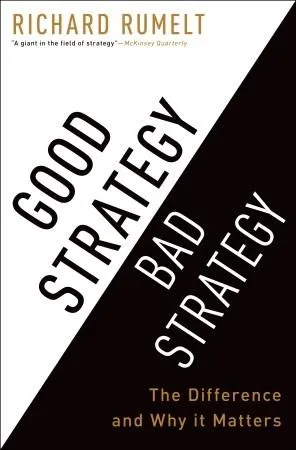
The Kernel
A strategy is three things: a diagnosis of what is actually going on, a guiding policy for dealing with it, and coherent actions that carry it out.
The parts form a chain, and each inherits the errors of the one before. A brilliant policy resting on a wrong diagnosis is worse than no strategy, because the organization now executes confidently in the wrong direction. The diagnosis deserves the most scrutiny, and it’s the part most often skipped.
The test for any strategy document: can it be wrong? If nothing in it could turn out false, it isn’t a strategy.
Bad Strategy
Bad strategy has recognizable tells: fluff, failure to face the problem, mistaking goals for strategy, and bad objectives.
“We want it very badly” is not a strategy. Neither is “grow 30%”. That’s a target with no account of how. And if you don’t think you can compete, don’t do it.
Leverage
Good strategy works by applying focused energy where you have the greatest leverage.
Coordination Is Learned in Layers
Coordinated action builds in layers. You learn to coordinate your legs for walking before you can coordinate a sprint.
Organizations work the same way. Product and engineering, sales, and marketing have to learn to coordinate first. Only then can the organization pursue the proximate goals of a strategy that is harder to execute.
Strategy Is Experimentation
Building a strategy resembles experimenting more than logical deduction. You don’t reason from a coherent, known reality to the core truth. You hypothesize your way toward incrementally more effective ways of acting.
One technique for critiquing your own judgment: hold a conversation with an imagined panel of experts. Which leaves the useful question of who sits on yours.